FUNERAL DIRECTORS OR MORTICIANS PROFESSIONAL LIABILITY INSURANCE
(January 2025)
Funeral directors or morticians and their
employees face malpractice exposure arising out of their professional
operations.
|
Example: Plaintown Funeral Home provided a memorial service for
the Jones family, including cremating Mr. Jones. The home’s director gave the
cremains to Mr. Jones’ daughter. Two weeks after the service, Plaintown
received a request from Mr. Jones's son who lives in another state. He claims
that he was supposed to get the cremains and not his sister. He files suit
against Plaintown. |
The Insurance Services Office,
Inc. (ISO) offers professional coverage for funeral directors or morticians
under their businessowners program (BP 08 02) and their Market Segments product
(MS FH 05). Not all companies have adopted the ISO programs, and not all
funeral directors qualify for them, so coverage may vary substantially among
different insurers.
Related Article: 194. Market Segments
Division—Funeral Homes
Funeral Directors professional
liability coverage is usually written as an endorsement to the insured’s
general liability policy that covers the funeral director's operations and
premises hazards. Some insurers offer complete independent package policies
combining property, general liability, and professional liability coverages for
funeral directors under a special group program.
COVERAGE
Funeral Directors professional
liability is not standard coverage. The language of the insuring agreements and
exclusions will differ between insurers, which makes a careful comparison
between forms important to discover potential gaps in coverage. The following
coverage information is based on a review of several independent policies
issued by different insurers and the ISO endorsements cited above.
Funeral Directors or Morticians
Professional Liability insurance typically pays on behalf of the insured. It
pays only the amount an insured is legally obligated to pay. The only amounts
it will pay are for damages that arise from either the rendering of or the
failure to render professional services.
These professional services must
be directly related to the insured’s funeral director or mortician business.
The damages must be due to bodily injury, property damage, personal and
advertising injury, or other injury. Bodily injury, property damage and
personal and advertising injury are all defined terms within the commercial
general liability policy. However, other injury is not defined, which leaves
this coverage open-ended.
Bodily Injury
Bodily injury is often defined as
bodily injury, sickness, disease, or death. It is important to remember that a
deceased body cannot sustain bodily injury, so the persons who sustain the
bodily injury are those who are living at the time of the activity causing the
bodily injury. Damage to the body is considered property damage.
Note:
This definition of bodily injury does not include mental anguish. Some coverage
forms might include such terminology in this definition. While other forms
might consider it, as ISO seems to, as other injury.
Personal or Advertising Injury
This is any injury that arises out of
one or more of the following offenses but, in this coverage, applies only in
relation to professional services. It includes consequential bodily injury.
a. False
arrest, detention, or imprisonment
b. Malicious
prosecution
c. Wrongful
eviction from, wrongful entry into, or invasion of the right of private
occupancy of a room, dwelling or premises that a person occupies when committed
by or on behalf of the property owner, property owner, or lessor
d. Any oral or
written publication of material that slanders or libels a person or
organization or disparages a person's or organization's goods, products, or
services. This can occur using any form of communication, including the
Internet and other electronic forms.
e. Oral or
written publication of material that violates a person's right of privacy. The
violation can occur using any form of communication, including the Internet and
other electronic forms.
|
Example:
Paragon Funeral Home prepares the body of Ms. Mega
Star. A tabloid offers money for pictures of the body before and after
embalming and a copy of the sealed cause of death. The family sues Paragon
for invasion of privacy when the tabloid publishes the pictures and releases
the cause of death. Paragon denies the allegations, and their insurance
carrier defends them. |
f. The named
insured using the advertising idea of another in its advertisement
g. The named
insured's advertisement infringing on the copyright, trade dress, or slogan of
another
Property Damage
This covers damage to tangible objects including resulting loss of
use. Deceased
bodies or cremated remains are considered property, so any damage to them is
considered property damage. Some forms do not cover damage to the deceased body
or cremated remains, but the ISO endorsements do.
|
|
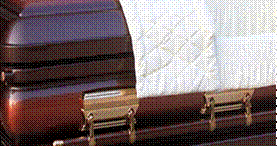
Example:
Family members witness a loved one's casket falling out of a hearse on the
way to the cemetery. The damage is eligible for coverage. |
Other injury
Other injury is not defined within the ISO endorsements.
Mental anguish, mental distress, and other emotionally/stress-induced injuries
could be covered. Most claims under this coverage would be classified as other
injury.
|
Examples: The following are instances of other injury
that may be eligible for coverage: § A person who discovers the wrong body was buried in
her husband’s grave § A mortuary staffer damages a body during
preparation or embalming process
|
§ Family
members suffering from seeing the wrong body displayed during a visitation or
funeral service § A
deceased is mistakenly cremated rather than prepared for a funeral service
and burial § Anguish
caused to a family learning, in error, a loved one's body was delivered as a
cadaver donation to an out-of-state hospital § Family
members distressed when a body is embalmed, contrary to their religious
beliefs §
Emotional distress when a funeral
home follows body preparation and funeral directions from an unauthorized
party. |
Defense
This provides protection for the
customary expenses found in most liability insurance contracts for defense, settlement,
and supplementary payments. While the ISO endorsement provides defense coverage
in addition to the policy limits of liability, this is not true of all
professional liability policies that cover funeral directors. Some include
defense expenses within the policy’s limit of liability; others will have a
separate, stated limit for defense coverage. Ensure you have carefully reviewed
the contract concerning defense expense coverage.
EXCLUSIONS AND LIMITATIONS
Since most funeral directors' or
morticians' professional liability forms are endorsements of a general
liability coverage form, all exclusions still apply unless they are specifically
removed or modified in some way. This means a few reviews are required.
1. Many commercial general
liability exclusions state that they apply to bodily injury, personal and
advertising injury and/or property damage. When coverage in the funeral
director’s form extends to other injury or another type of injury, these
exclusions would NOT apply to those types of injury unless the exclusion is reworded
to add the new term.
2. Some commercial general
liability forms exclude professional coverages. Such exclusions would need to be
modified or eliminated to prevent confusion.
3. Most forms modify exclusions.
The following amendments are examples:
a.
Contractual liability
This is modified by adding the
term “other injury.”
b.
Criminal Acts
This is modified by adding the
term “other injury.”
c.
Care, Custody and Control
The deceased body, plus personal
clothing, jewelry, and more, are placed in the care, custody, and control of
the funeral director. The standard property damage exclusions would deny
coverage for any loss to these items. However, most policies will provide
coverage subject to limitation of perils.
The ISO endorsements provide coverage if the
property damage is caused by theft or a hostile fire while other forms may
expand to provide coverage for other specified perils.
|
Example: Geoffrey and Sons have control of Melanie’s furs
and rings placed on her during the visitation but were removed before the
sealing of the casket. Jessica, Melanie’s daughter, takes all of these at the
same time she is picking up flowers and other items at the funeral home.
Patricia, the executor of Melanie’s estate, arrives at the funeral home and
requests the items. Patricia is furious that they are no longer available and
sues Geoffrey’s on behalf of the estate because Melanie has left the state
and cannot be found. If the items were taken when employees were out of the
area, this could be theft and covered. If an employee gave the items to
Jessica, this action may be excluded. |
d.
Damage to Your Work
The exclusion does not apply to property
damage caused by the named insured’s work or work provided by others on its
behalf. This is important because if there is no property damage for the named
insured’s work, there is no property damage coverage for the deceased body.
|
Example:
Paisley Place Funeral Home failed in its embalming so much that no attempt
was successful in making Eric look natural. The family had to change their
plan to have an open casket. Later, the family sued Paisley for the damage to
the body and their related mental anguish. |
e. Damage to a Particular Part of
Property Being Worked On
Like the
damage to your work exclusion, this exclusion removes coverage for the
particular property on which the named insured or others on its behalf are
working. If this exclusion is on the policy, there is no coverage for the
deceased body. The ISO forms eliminate this exclusion.
|
Example: Marcia is shocked to discover that the funeral
home broke the legs in her father’s body to fit him into the standard-sized
casket it had ordered. She sues the funeral home for the damage to the body
and the accompanying mental distress. Damage to the body could be covered due
to this revised property damage exclusion. |
4. While all exclusions are
important, the following are particularly important to this coverage:
- Intentional acts by the named insured or ones acting on its
behalf. As an example, while misdelivery of the wrong body for scientific
research is covered, intentional sale of the body or body parts is not.
|
Example:
Beloved Mortuary Inc. is insured by Grounded Fire & Casualty's Funeral
Director's policy. Beloved is sued by the spouse of Joe Smith after she
discovers that, without legal permission, Joe's kidneys and liver were sold
to an area tissue bank. Grounded notifies Beloved that their intentional and
criminal act is excluded from coverage. |
·
Fraud,
misrepresentation, violation of any law or ordinance, or criminal act
Note: This exclusion does not apply to
an act done in good faith at the request of a public official having apparent
authority to require or permit such an act.
|
Example: The city coroner signed a contract with Julian’s
Funeral Home to cremate unclaimed bodies after a
tissue bank had harvested tissue from them. Julian’s was unaware the city
coroner was pocketing the money and had no authorization to enter into this
contract. Julian’s performed its function as required based on its contract. One
of the families of a deceased sued the city coroner and Julian’s. Julian’s
was covered because, while the action was a criminal act by the city coroner,
Julian’s was acting in good faith. |
·
Liability
assumed by the insured under any contract or agreement
Note:
This exclusion does not apply to liability for damages otherwise eligible for
coverage under the policy.
·
Damages
related to the ownership, maintenance, or use of any automobile or animal-drawn
vehicle while away from any premises owned, rented, or controlled by the
insured
|
Example:
Beloved Mortuary Inc.’s hearse is transporting a
casket and the deceased to a nearby cemetery. On the way, the hearse’s driver
makes a turn too sharply, runs up on a corner curb and injures a pedestrian.
A claim is turned in under their Funeral Director's policy. A company claims
supervisor tells them that coverage is excluded under the funeral director
policy, but they are processing the claim under Beloved’s Business Auto
Policy. |
·
Property
damage to any property or facility an insured owns, occupies, rents, or holds
on consignment.
Note: These
property exposures should be covered under an insured’s property policy or
property section of a commercial package policy.
·
Damages and
expenses related to the release, disposal, etc., of medical waste and chemicals
used with embalming, preparations, and related activities
Note: These
exposures would have to be managed by securing a pollution liability policy.
DEFINITIONS
Some forms add definitions for
only the Funeral Directors or Morticians Professional coverage that alter
definitions in the commercial general liability coverage part. The following
are examples:
Damage to Deceased
Typically, it refers to physical
loss involving the deceased person, cremated remains, clothing, and personal
effects.
Deceased Human Body
Includes an entire human body,
any part of a human body that has been severed, or ashes of a human body after
legal cremation.
Occurrence
Means an event causing bodily
injury, property damage, or personal and advertising injury. It also includes
errors, omissions or acts while rendering or failing to render professional
services as a funeral director or a mortician.
Professional Services
Malpractice errors or mistakes in
the embalming, handling, disposition, burial, disinterment, or removal of any
deceased human body or any conduct of any memorial service by the insured, even
though no deceased human body is present. Injury to, destruction of, or
interference with the right of burial of a deceased body is also included.
IMPORTANT PROVISIONS
Funeral directors and mortician’s
professional liability insurance applies only to acts or omissions that occur
during the policy period and arise out of the rendering of or failure to render
professional services. This coverage is generally written on an occurrence
basis.
The insured must provide written
notice to the company or an authorized agent as soon as possible when they
become aware of any injury, loss, or event covered by the policy. This also
applies to any claims alleging malpractice, error, or mistake committed by the
insured. The notice must be made in accordance with stated policy conditions.
Related Court Case: "Notice to Broker
Was Not Notice to Insurance Company" – illustrates the importance of
proper notification of insurer.
Insurance can be written on
either a single-limit basis, where one total limit covers all damages resulting
from errors or mistakes during the policy period, or on a dual-limit basis,
which includes a specific limit for each claim and an aggregate limit that
covers all damages incurred within the policy period. Review the policy
carefully for specific provisions pertaining to the limit of liability.
ADDITIONAL COVERAGES
This depends entirely upon the
applicable company, but some insurers may offer distinct types of optional,
additional coverages related to funeral director activities, such as:
- Loss or
damage to property left in the funeral director’s care or custody
- Damage
to autos that is caused due to valet parking, storage, or directed parking
while preparing for travel to graveside services
- Errors
and Omissions or pre-need service plans
- Exhumation
Expense